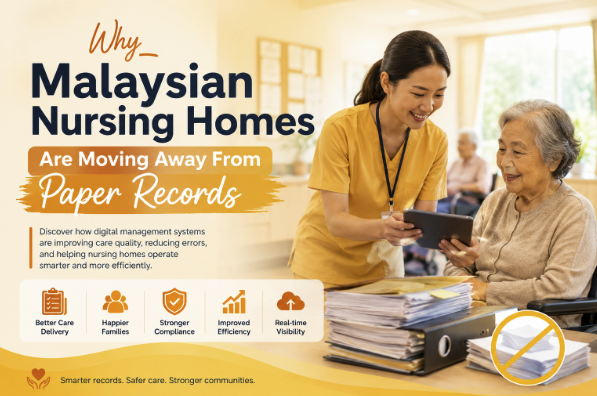
Why Malaysian Nursing Homes Are Moving Away From Paper Records
Walk into most nursing homes in Malaysia today and you’ll still find the same thing: thick binders on the nurse’s desk, handwritten daily logs, stacks of resident files, and a whiteboard tracking who has and hasn’t taken their medication.
For many operators, this is simply how things have always been done. And for a long time, it worked, when homes had fewer residents, smaller teams, and simpler regulatory requirements.
But Malaysia’s elderly population is growing fast. Families are more demanding. Staff turnover is high. And regulators are paying closer attention. What once felt manageable on paper is now quietly causing serious problems and costing nursing home operators more than they realise.

The Reality of Paper-Based Management in Malaysian Care Homes
Paper records are not just inconvenient. They create real operational risks that affect resident safety, staff efficiency, and family trust every single day.
Here is what a typical day looks like in a paper-dependent nursing home:
A caregiver finishes the morning round and needs to log vitals for 20 residents. She writes each one by hand in a physical logbook. If her handwriting is unclear, the next shift nurse misreads a blood pressure reading. No alert is triggered. No one follows up.
At the end of the day, the admin tries to compile an incident report for a resident who had a fall earlier that week. The notes from the caregiver on duty are in one binder. The nurse’s observation is in another. The family update was given verbally and never written down. Putting together a complete picture takes over an hour and something is always missing.
A family member calls to ask how their mother is doing. The person who picks up the phone was not on duty that morning and cannot find the right file quickly. The family hangs up frustrated, wondering whether their loved one is actually being cared for properly.
These are not rare situations. They happen daily in care homes across Johor Bahru, Kuala Lumpur, Penang, and beyond.
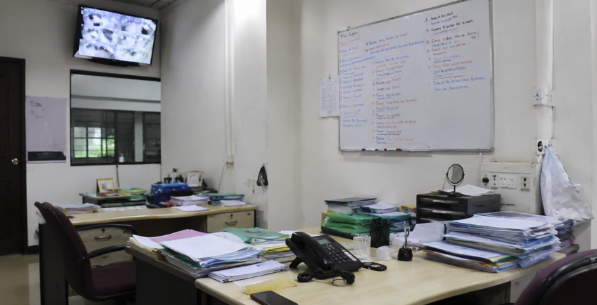
At one of the premium care centres in Putrajaya that we visited, staff shared that tracking a resident’s records across different files and shifts was one of their biggest daily frustrations. Files were difficult to organise, information was scattered, and finding specific historical records took far longer than it should. For a team already stretched across 50 residents, that lost time adds up quickly.
The Hidden Costs of Paper Records
Most nursing home operators think of paper as free. In reality, it carries significant hidden costs.
1. Staff time wasted on documentation
Studies show that care staff in paper-based facilities spend a significant portion of their shift on documentation rather than actual care. Writing the same information into multiple logbooks, copying records from one shift to the next, and searching for filed documents all eat into time that should be spent with residents.
In a home with 30 residents, this can easily add up to 2–3 hours of wasted staff time per day across the team. Over a month, that is the equivalent of losing a full-time staff member to paperwork.
2. Errors that put residents at risk
Handwritten records are prone to mistakes — illegible writing, missed entries, and information that simply does not get passed from one shift to the next. In elderly care, these errors can have serious consequences. A missed medication dose, an unrecorded vital sign spike, or a fall that goes undocumented can all escalate into something far more serious.
3. Family complaints and loss of trust
Malaysian families take the care of their elderly parents seriously. When they call and staff cannot give them a clear update, or when they feel they are being kept in the dark, trust breaks down quickly. In a community where word of mouth travels fast — especially within Chinese, Malay, and Indian family networks — one unhappy family can affect your home’s reputation significantly.
4. Compliance risk
Nursing homes in Malaysia operate under the Ministry of Health and are subject to inspections and audits. Paper records that are incomplete, disorganised, or illegible put operators at risk during these reviews. As regulations tighten — particularly with the anticipated full enforcement of the Private Aged Healthcare Facilities and Services Act (PAHFAS) — documentation standards will only become more stringent.
5. No visibility across shifts
When a nurse ends her shift and hands over to the next, she relies on verbal briefings and handwritten notes. Critical information gets lost in translation. The incoming nurse has no quick way to see the full picture of every resident’s status. This shift-handover problem is one of the leading causes of care errors in nursing homes — and paper makes it worse.

What Modern Nursing Home Management Looks Like Today
The good news is that digitising operations no longer requires complicated IT infrastructure or expensive enterprise systems.
Modern eldercare management systems are designed specifically for caregivers and nursing home operations.
Most systems are simple enough to use directly from a smartphone or tablet.
With a digital nursing home management system:
- Caregivers can record vitals instantly during rounds
- Medication administration is tracked digitally
- Incident reports are submitted immediately
- Shift handovers become more structured
- Management gains real-time operational visibility
- Families receive faster updates
Instead of relying on fragmented paperwork, all records are centralized into one platform.
This improves coordination between caregivers, supervisors, admins, and management teams.
Is Digital Reporting Difficult for Caregivers to Learn?
One common concern among nursing home operators is whether staff members will struggle to adapt to digital systems.
In reality, modern nursing home software is designed to be simple and practical for daily operations.
Most caregivers can learn the system quickly because:
- Mobile interfaces are straightforward
- Reporting workflows are simplified
- Forms are standardized
- Updates can be completed in real time
With proper onboarding and training, many care homes are able to transition smoothly from paper workflows to digital reporting.
FAQ About Elderly Care Management Systems
Is paper documentation still common in Malaysian nursing homes?
Yes. Many nursing homes in Malaysia still rely heavily on manual paperwork, printed forms, and handwritten caregiver reports.
Can caregivers use nursing home software on mobile devices?
Yes. Most modern eldercare management systems support mobile or tablet access for easier real-time reporting.
Is digital reporting suitable for small nursing homes?
Yes. Even smaller care centres can benefit from improved reporting consistency and operational visibility.
The Future of Elderly Care Operations Is Digital
The question is no longer whether nursing homes in Malaysia will eventually go digital.
The real question is how much longer operators can afford to rely on fragmented paper workflows as operational complexity continues increasing.
Care homes that digitise earlier will be better positioned to improve operational efficiency, reduce reporting errors, strengthen family trust, and scale more effectively in the years ahead.
For nursing homes still relying on paperwork, now may be the right time to explore a simpler and more structured way to manage daily operations.
Is Your Nursing Home Ready to Make the Switch?
If any of the scenarios in this article sound familiar, you are not alone. The majority of nursing homes in Malaysia are still operating on paper, not because it is better, but because no one has shown them a simpler way.
The question is not whether to go digital eventually. The question is how much longer you can afford not to.
ElderCare+ is a nursing home management system built for Malaysian care homes. Staff can record daily tasks, vital signs, and incidents directly on their phones. Families receive real-time updates through a dedicated app. Admins can manage multiple centres from one dashboard — in Malay, English, or Chinese.
No complicated setup. No long contracts. And your team can be trained and ready in a single session.
Book a free demo today and see how ElderCare+ works in a real Malaysian care home setting.
ElderCare+ is developed by 8Creation, a Malaysian technology company building digital solutions for the healthcare and care centre industry. To learn more, visit 8creation.com.my.
For nursing home operators and families looking for trusted elderly care resources, Senior Living Malaysia provides an independent directory of senior care homes and services across Malaysia.